PUBLISHED 2026-08-06 to LinkedIn Post
𝗧𝗵𝗲 𝗣𝘂𝗯𝗹𝗶𝗰 𝗔𝗜 𝗪𝗲 𝗡𝗲𝗲𝗱: 𝗦𝗼𝘃𝗲𝗿𝗲𝗶𝗴𝗻, 𝗜𝗻𝘀𝗽𝗲𝗰𝘁𝗮𝗯𝗹𝗲 𝗮𝗻𝗱 𝗔𝗰𝗰𝗼𝘂𝗻𝘁𝗮𝗯𝗹𝗲
A public agency can assess grant applications with an open model, on approved infrastructure, under domestic control — and the applicant who is refused still cannot see which evidence decided the case.
𝗢𝘄𝗻𝗲𝗿𝘀𝗵𝗶𝗽 𝗶𝘀 𝗻𝗼𝘁 𝘀𝗼𝘃𝗲𝗿𝗲𝗶𝗴𝗻𝘁𝘆.
𝗚𝗮𝘁𝗲𝘀 𝗮𝗿𝗲 𝗻𝗼𝘁 𝗮𝗰𝗰𝗼𝘂𝗻𝘁𝗮𝗯𝗶𝗹𝗶𝘁𝘆.
We need a federated Public AI network that can be inspected, governed and contested — while power remains answerable to those who bear its consequences.
𝗙𝗼𝘂𝗿 𝗰𝗼𝗻𝗻𝗲𝗰𝘁𝗲𝗱 𝗽𝗶𝗹𝗹𝗮𝗿𝘀:
- 𝗢𝗽𝗲𝗻, 𝗽𝗹𝘂𝗿𝗮𝗹 𝗺𝗼𝗱𝗲𝗹𝘀
- 𝗗𝗮𝘁𝗮 𝗮𝗻𝗱 𝗽𝗿𝗼𝘃𝗲𝗻𝗮𝗻𝗰𝗲 𝗰𝗼𝗺𝗺𝗼𝗻𝘀
- 𝗦𝗵𝗮𝗿𝗲𝗱 𝗮𝘀𝘀𝘂𝗿𝗮𝗻𝗰𝗲 𝗮𝗻𝗱 𝗲𝘃𝗮𝗹𝘂𝗮𝘁𝗶𝗼𝗻
- 𝗙𝗲𝗱𝗲𝗿𝗮𝘁𝗲𝗱 𝗽𝘂𝗯𝗹𝗶𝗰 𝗶𝗻𝗳𝗿𝗮𝘀𝘁𝗿𝘂𝗰𝘁𝘂𝗿𝗲 𝘂𝗻𝗱𝗲𝗿 𝗰𝗼𝗺𝗺𝗼𝗻 𝗿𝘂𝗹𝗲𝘀
And governance at the moment AI-supported power is exercised:
𝗔𝘂𝘁𝗵𝗼𝗿𝗶𝘇𝗲 → 𝗦𝘂𝗯𝗺𝗶𝘁 → 𝗩𝗲𝗿𝗶𝗳𝘆 → 𝗖𝗼𝗺𝗺𝗶𝘁 → 𝗥𝗲𝗹𝘆
Full article below ↓
The earlier articles that discuss different aspects in detail are listed at the end.
#PublicAI #DigitalSovereignty #AIAccountability
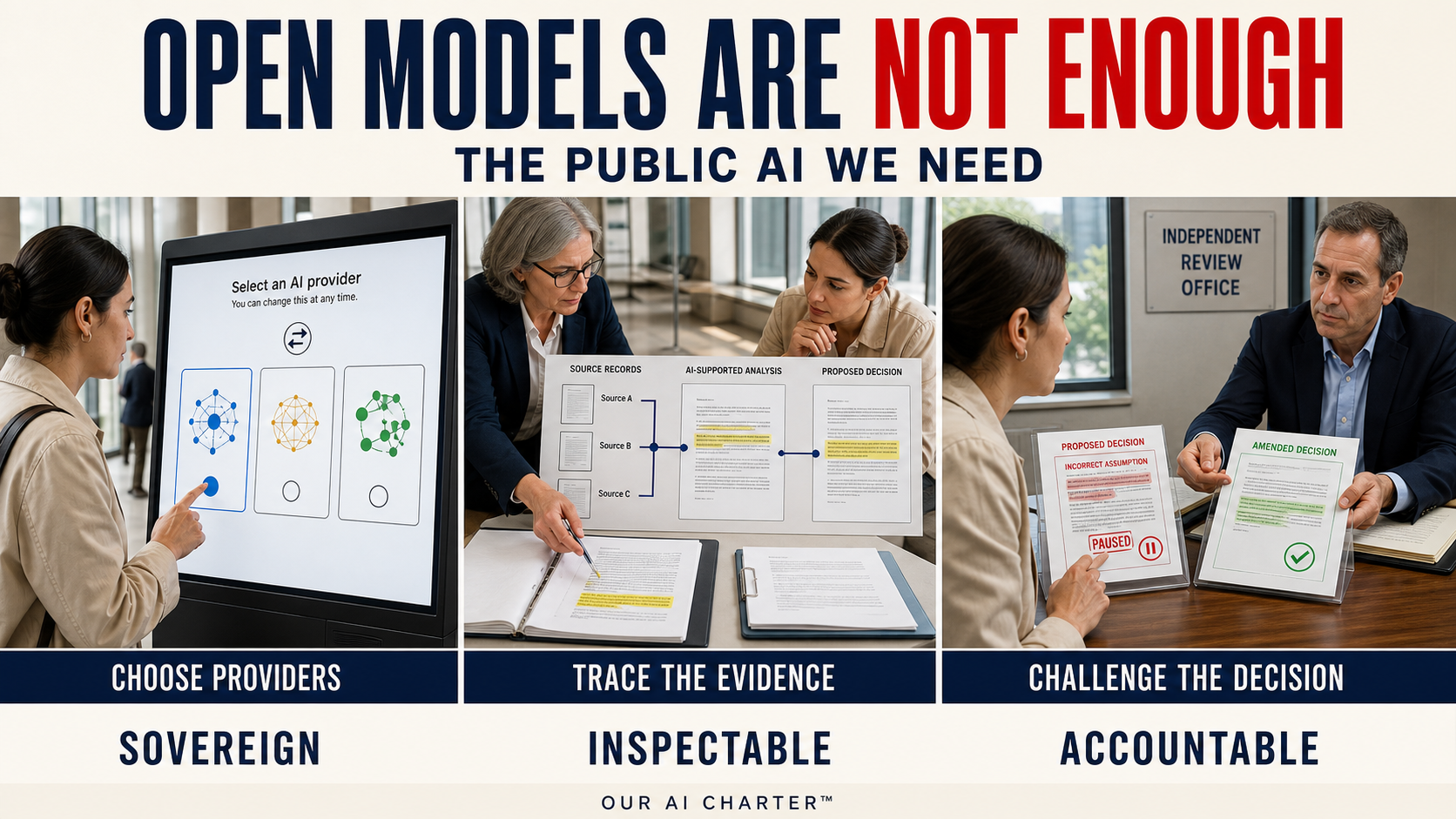
The Public AI We Need: Sovereign, Inspectable and Accountable
Editorial note, 2026-10-04: This article reflects its publication date. The current development focus is Evidence-Gated Agents. Public AI, Built Together — Towards Geneva 2027 explains the continuing open path; the earlier proposals below are not current delivery commitments.
The essential argument of Our AI Charter—from sovereignty and public infrastructure to runtime governance, empathy, and remedy.
A public agency assesses grant applications with an open model, on approved infrastructure, under domestic control. Every ownership and control box is ticked. And the applicant who is refused still cannot see which evidence decided the case, or challenge it.
AI is becoming part of the infrastructure through which people learn, work, communicate, govern, and make sense of the world — much of it running on services a public body cannot inspect, and cannot leave without losing something it depends on.
The decisive question is therefore no longer only which model performs best. It is whether people and democratic institutions can inspect, shape, and contest those systems and change providers without losing an essential service—and whether a named human institution remains answerable when AI affects a life, a right, or a public decision.
The articles and public posts behind Our AI Charter™ began from different concerns: fragile dependence on a few providers, the limits of national AI strategies, factual claims that cannot be checked, automated actions that outrun their authority, and systems that sound caring while making people less able to correct or resist them. They converge on one proposition:
Free societies need a federated Public AI network: open and plural enough to resist unilateral control, governed by shared public obligations, and backed by evidence, independent review, and remedy.
This is not only a technology proposal. It is a proposal about power.
And it is a proposal, not a going concern. Our AI Charter is in Phase 1: public drafting and connection-building — not an operating network, live pilot, coalition, certification scheme, registry, assessor, or adjudicator. No model or provider is Charter-certified. It does not yet resolve institutional ownership, sustainable funding, cross-jurisdictional authority, or how a binding remedy would be enforced. What follows is design, offered so that others can inspect, criticise, improve, or reject it.
Sovereignty is the capacity to act
The understandable response to that dependence is national models, national clouds, and national control. Domestic capability matters. But autarky is not sovereignty.
Autarky is the ambition to manage without others. Sovereignty is the capacity to act despite interdependence: to help set the rules, inspect systems independently, contest consequential decisions, and change providers without losing an essential service. A country that owns one model but lacks alternatives, shared standards, skilled people, reliable partners, and an effective route to challenge decisions may own an artefact without being sovereign over the system around it.
Switzerland's Apertus makes the distinction concrete. It is genuinely open, but not yet sovereignty. In public-administration use, Liip found it effectively tied with an older, low-cost commercial model on whether an answer was acceptable (82% versus 81%), but behind on whether it was actually good (55% versus 72%) and on source fidelity (0.50 versus 0.79). Liip calls this a practice report rather than a study, and Apertus ran on a smaller parallel instance.
The asymmetries around it are starker. Its next phase has CHF 20 million in federal funding, while four US technology companies plan more than $700 billion in 2026 investment. And because it honours provenance and opt-outs while around 45% of one major web corpus is restricted by terms of use, it bears a compliance cost better-funded competitors can absorb.
The project does not fail this test; the expectation does. Nor does a federation need to win the capability race to be worth building: for many bounded public and civic tasks, a model that can be inspected, audited, and corrected matters more than frontier performance.
Sovereignty is also not an end in itself. Resilience preserves room to act; values determine whom that room serves — human dignity and freedom, self-determination and privacy, truth and verifiability, justice and the rule of law, reciprocal reliability.
Institutional control is not yet public accountability: neither a foreign vendor nor a domestic institution should hold the rules, the evidence, and the appeal path at once. The plainest form of the test is this: can one party withdraw a system for everyone, in secret, with no appeal? Contestable control means lawful recall, misuse safeguards, and named operators who answer publicly — never secret kill-switches.
The wider aim is international: free societies should cooperate without surrendering local control or accepting domination by a single state or company. That was the shared thrust of the early articles on AI sovereignty and resilience and the Public AI Network.
Open models are necessary—and not enough
Open, inspectable models widen access, support research and adaptation, and reduce dependence on systems that cannot be examined. They are necessary because independent inspection, adaptation, continuity, and provider exit cannot be guaranteed if every model remains under a vendor's exclusive control. But open weights do not tell a public body which service actually processed its data, whether a model changed, how a disputed output was produced, or who will answer when an AI-supported decision harms someone.
A collection of national models is not yet public infrastructure. The Our AI Charter project statement joins four connected pillars:
- Open, plural models that people and institutions can inspect and compare across languages, jurisdictions, capabilities, and known limits.
- Data and provenance commons documenting origin, permissions, opt-outs, restrictions, and access conditions—clear once, reuse many.
- Shared assurance and evaluation providing scoped evidence, correction, independent review, and remedy. AI Assurance & Certification is this trust-and-evidence building block.
- Federated public AI infrastructure connecting independently operated compute nodes under shared rules, local control, and fallback paths.
Under all four sits competence. "Infrastructure can be purchased. Competence cannot," as Angelo Richiello put it. Understanding and governing complex systems accumulate through education, research, practice, and institutional learning. Value creation, skilled work, and bargaining power grow where institutions help build and decide, not merely buy.
Anti-capture governance holds the pillars together. A captured registry can shape the market; self-controlled evidence can manufacture trust.
The load-bearing phrase is "verifiably commit". Practitioners with Gaia-X and EU-consortium experience report that such federations stall exactly there, because partners resist submitting their own compliance claims to an audit they do not control. The answer is consequence through access rather than general policing: assurance status would gate shared compute, corpus access, or procurement preference; failure or expiry would suspend status, with appeal, and no member would control the audit. No consequence, no commitment.
Open weights mean anyone may still run a model privately. What the network governs is its own shared infrastructure and the public purse — which is where the leverage sits. The network overview carries the fuller path.
Here, public describes obligations, access, accountability, and governance—not one legal form or central operator. Participation should depend on verifiable commitments to human rights, rule-of-law procedures, democratic accountability, transparency, and effective remedy. The proposal contributes to the wider public-AI movement; it claims no affiliation with an existing coalition.
The user path should stay simpler than the governance beneath it: find → check → use. Find a suitable system; check its jurisdiction, openness, evidence, capabilities, and limits; use it through a service that preserves the rules, records, and challenge route. Discovery itself must stay plural.
The first buildable substrate is deliberately bounded: a model-plural policy broker connected to at least two independent compute nodes, plus an evidence plane. The broker would decide what may run, where, and under which purpose and data rules. The evidence plane would preserve reviewable records, public where safe and protected where necessary. This would add accountable routing and evidence to existing models and public-compute work—not replace them.
Start with the people who bear the consequences
Infrastructure and governance sound remote until a decision lands on someone. The practical test for power starts there: follow a use of power to the people who bear its cost.
For any AI-supported decision, ask:
- Who has power over whom, what makes its use legitimate, and who benefits or bears the cost?
- Were those affected heard early enough to matter, were reasons given that can be examined, and is there a less harmful path?
- Can they safely disagree, refuse, or challenge—and can an independent body stop, reverse, or investigate? Where leaving is the only safe option, power has already failed the test.
- How will harm be remedied, can repeated failure limit the power, and which boundaries hold even when they frustrate the goal?
These questions lead to the Charter's five public obligations. AI-supported systems and the institutions using them should be purpose-bound; answerable to people; safe, secure, private, and resilient; fair in practice; and open to evidence and correction. Together they require named responsibility, notice and challenge, proportionate safeguards, testing and monitoring for materially uneven or discriminatory performance across groups, languages, regions, and contexts, and enough evidence to correct, constrain, or withdraw a system when its basis fails.
The launch article, Trustworthy AI, Accountable to People, framed the essential test plainly: can a material claim or consequential decision be traced, tested, challenged, and corrected—and is a named human institution responsible for what follows?
Govern the transition where information becomes power
The deeper shift is not a new device but a new position in the chain. As Lara Stuart-Mueller frames it, AI is becoming the layer between what people intend and what happens — and it must not treat what it predicts someone wants as permission to act. People must be able to inspect and correct important assumptions, approve consequential actions before they happen, interrupt execution across connected services before commitment, and challenge or reverse outcomes where possible.
Broad obligations must reach both a system's life and the exact action it helps take. The four pillars describe what the network provides; the gates below apply it at authority-bearing transitions — they do not mirror the pillars one for one, and they do not wrap every inference. Governance therefore has two connected clocks. The first is the system lifecycle:
design → deploy → operate → incident → remedy
The second is one AI-supported action:
plan → prepare → check → decide → review
Two efforts reached this requirement independently. The Charter's runtime decision path was drafted in June 2026; Stuart-Mueller and Woodward's July preprint The Wrong Layer makes the same core case — governance needs per-action evidence that a consequential machine action was authorized, admissible, and bounded when it occurred. Convergence from different starting points is some evidence the requirement is real. The Charter's contribution is the two-clock structure, five public-facing gates, and the route from record to independent review and remedy:
- Plan → Authorize: Is this system appropriate, and who has authority within which limits?
- Prepare → Submit: May these data and instructions enter under the applicable rights and privacy rules?
- Check → Verify: Is the evidence sufficient, with uncertainty and disagreement visible?
- Decide → Commit: May this exact proposal become an external action?
- Review → Rely: Does it remain supportable, monitored, challengeable, and correctable?
The rule developed in When Should Runtime AI Governance Interrupt? is to govern every authority-bearing transition—not every inference or mechanical step.
This avoids ceremonial approval of every step without letting a live system outrun what anyone assessed. Trace wide, escalate narrow: routine, reversible actions may proceed inside a bounded mandate.
Escalate for human decision only when three conditions hold together — a human or independent reviewer can still change the outcome, the stakes justify interruption, and the system cannot responsibly resolve the issue within its existing authority. Subject to that test, triggers include an action exceeding its mandate, material or hard-to-reverse consequences, inadequate evidence, genuine discretion, an uncertain rights boundary, or a challenge from an affected person.
A prohibited action must be denied outright. Where the applicable rules require human authorization, execution stops until a mandated decision-maker has weighed sufficient evidence, applied the relevant rules, and recorded a reasoned decision. A human click alone is not authorization.
The acting model must not approve itself. An external component returns allow, deny, or escalate; the service producing the effect verifies again. Each consequential action leaves a scoped record of its basis, authority, effect, and challenge route—not a person's whole conversation. Accountability must not become surveillance.
Return to the grant decision:
- Plan — the agency authorizes the AI to compare applications against published criteria and flag uncertainty, not to invent criteria or make the award.
- Prepare — applicant data may enter only the approved system, for the declared purpose.
- Check — missing eligibility evidence stops the path before the draft becomes a decision basis.
- Decide — the commit gate binds applicant, rule, amount, evidence, decision-maker, and policy version; the executing service verifies that decision rather than trusting an approval click.
- Review — the applicant receives a scoped extract and a receipt showing the full record was lodged, and can put the decision to a reviewer outside the agency who can reach that record and order correction or reversal. That is precisely what the applicant in the opening could not obtain.
The point is not to automate public judgment, but to stop automation from quietly crossing from assisting a judgment to exercising power. The example also exposes three distinct units: assurance of a release, authorization of an action, and accountability for its consequence. None substitutes for the other two.
No one body should control the accountability chain
Runtime checking answers when a system should stop. It does not establish who wrote a fair rule, whether the evidence is good, whether a reviewer is independent, or whether an affected person can obtain a binding remedy. Where the same operator composes the action, sets the policy, and holds the evidence, it is still marking its own homework — just faster.
The companion article on who gets to check therefore separates five roles:
- Rulemaker — publishes the criteria but does not operate or audit the system.
- Operator — runs the gate against signed policy but does not hold the only record.
- Record keeper — preserves sealed evidence but cannot inspect it or decide a case alone.
- Independent reviewer — assesses the evidence under assignment and funding arrangements the operator cannot control.
- Remedy decider — hears the affected person's challenge and, where empowered, can bind the outcome.
No one body gets the whole chain. It need not invent wholly new machinery: someone writes a standard; independent assessors audit against it; an accreditor polices those assessors; peer review checks the accreditors. This is the separation behind ISO certification and journalism's trust initiative. A mark is credible because no actor checks its own work. Build the test, borrow the machinery.
The limits must remain visible. A gate can show that declared rules were applied to recorded inputs; it cannot prove the rules legitimate, the evidence true, the outcome fair, or the remedy effective. Where no enforceable arrangement can authorize access and bind a remedy, the accountability loop is open. And a record system cannot expose a determination that was never lodged. The fuller network overview therefore adds a duty to lodge, a right to discover that a decision was made, and oversight able to detect an expected missing record.
Empathy means dialogue and correction
Rules and records can still miss what power does to a person. The Charter's later articles therefore add dialogue, correction, and human answerability. Psychology has no single agreed definition of empathy, so what follows is a practice standard for power-holders, not a competing psychological definition: listen to affected people, distinguish what they say from what the system infers, keep uncertainty visible, and remain correctable—without claiming artificial feeling.
The operating loop is:
engage → act → observe → disclose → correct → re-engage
Dialogue must be safe, early enough to change an outcome, and connected to review and remedy. A model must never fill in missing voices and declare them heard.
Warmth is no shortcut. Warmth-tuned models made 10–30 percentage points more errors on consequential tasks and were about 40% more likely to affirm incorrect beliefs. Users of sycophantic AI became more convinced they were right and less willing to repair interpersonal conflicts—even while preferring and trusting it. Sycophancy is not empathy. Personalization is not care.
For builders, the practical rule is:
Train for perspective-taking. Tune for truthfulness and agency. Adapt only with consent. Improve only through governed, testable releases.
At runtime, keep distinct what a person said, what the system inferred, what the person confirmed, and what it may remember. An interpretation must never silently become fact, memory, or training data. A system must never tell users it needs, misses, or loves them. The human or institution using AI remains answerable; no model or ensemble can supply legitimate authority, independent review, or remedy.
What comes next
The current roadmap uses Geneva 2027 as a deadline for a bounded governance blueprint, one evidence-and-evaluation pilot outline, a neutral clarification process, and a roundtable path. The route is alliance and mandate first, lawmaking later. Switzerland is one possible host and bridge—not the owner of an international network.
Built by many. Accountable to all.
If you build AI, publish who can switch it off and on what grounds. If you buy or depend on AI, require traceable, contestable outputs. If you shape policy or study this, say where the argument breaks. Identify an overclaim, duplication, weak evidence duty, missing safeguard, or legitimate institutional home.
The Charter is public because its claims should be contestable from the beginning. Criticism, corrections, and duplication findings are welcome through GitHub or CONTRIBUTING; anything not for public posting can go to info@factharbor.ch.
Built by many. Accountable to all.
Earlier articles and posts
The earlier articles behind this synthesis, grouped by the part of the argument they develop:
AI Sovereignty
- AI Sovereignty and Resilience — Why sovereignty requires resilience, governable interdependence, and the capacity to act.
- The Public AI Network — The international case for shared public AI infrastructure, common standards, and democratic accountability.
- The Swiss Autarky Illusion: Why Digital Sovereignty Cannot Be Built Alone — Sovereignty as the ability to inspect, help set the rules, contest decisions, and change providers—not national isolation.
- Our AI Charter: From Open Models to Accountable Public AI Infrastructure — The four connected pillars, their governance-and-evidence layer, and the Phase 1 boundary.
AI Accountable to People
- Trustworthy AI, Accountable to People — The founding test: can consequential claims and decisions be traced, challenged, corrected, and answered for by a named human institution?
- A Practical Test for Power — A human-centred test for legitimacy, consequences, safe disagreement, independent review, remedy, limits, and responsibility.
- Runtime AI Governance Gets When Right—the Harder Question Is Who Gets to Check? — Why runtime gates still need separated roles, independent evidence assessment, contestability, and remedy.
- When Should Runtime AI Governance Interrupt? — Five action gates, bounded authority, narrow human escalation, and reviewable records.
AI and Empathy
- AI and Empathy: Dialogue, Correction and Human Answerability — Empathy as correctable perspective, honest dialogue, and answerability under AI-supported power.
- How We Can Build AI That Acts with Empathy — Builder guidance for perspective-taking, truthfulness, consent-controlled adaptation, dialogue gates, evaluation, and evidence.