PUBLISHED 2026-06-22 to LinkedIn Post
Open, publicly-funded AI models now exist across many regions — but real sovereignty and resilience come from what free societies build around them: shared standards, genuine accountability, and public compute, developed in the open.
AI is becoming infrastructure — and the real question isn't which model wins this quarter, but whether free societies can inspect, shape, and contest the systems they rely on. That is democratic resilience.
Public AI models already exist, but a dozen national models aren't yet a shared infrastructure.
The harder, less-funded work is around the models, and it reaches well beyond technology:
Coordination & standards Interoperability, shared openness criteria, a public model registry.
Governance & trust Evidence of real behaviour, clear accountabilities, resistance to capture.
Durable ecosystems Talent, research, shared public compute, lawful data commons.
So I'd like to open a conversation — and help connect the people and projects already doing this.
- Which part is most urgent?
- Who is already doing it well?
- Who should participate?
Add or tag them in the comments (I've listed a few to start), and let's connect the dots. 👇
#PublicAI #AIGovernance #DigitalSovereignty #OpenModels #TrustworthyAI
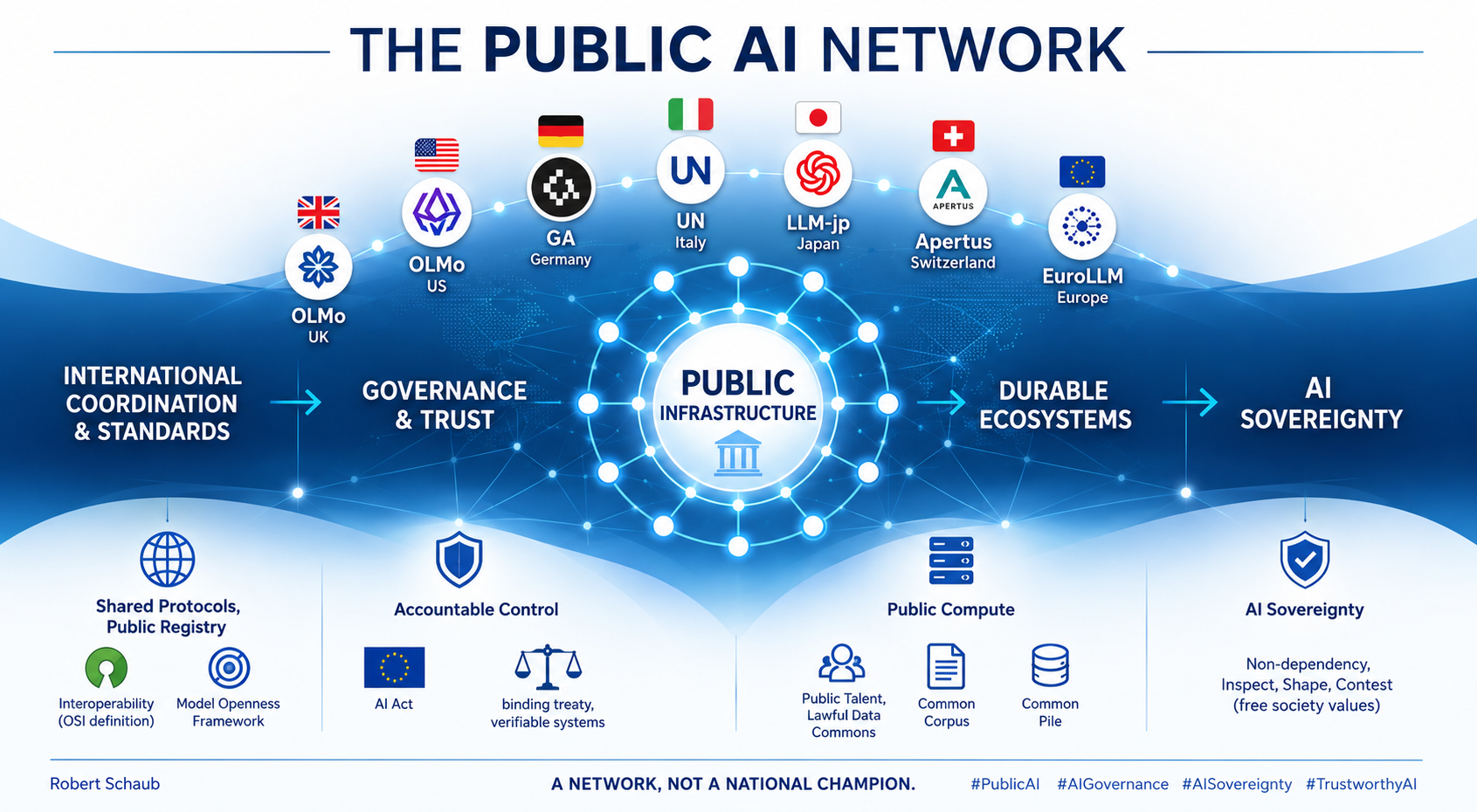
The Public AI Network: Building Sovereignty and Resilience for Free Societies
Editorial note, 2026-10-04: This article reflects its publication date. The current development focus is Evidence-Gated Agents. Public AI, Built Together — Towards Geneva 2027 explains the continuing open path; the earlier proposals below are not current delivery commitments.
Open, publicly-funded AI models now exist across many regions — but real sovereignty and resilience come from what free societies build around them: shared standards, genuine accountability, and public compute, developed in the open.
AI is fast becoming infrastructure — the layer through which people learn, work, govern, and make sense of the world. But unlike the infrastructures before it, most of it is owned by a handful of private firms, and much of how it works is hidden from the people who depend on it. The question is not only which model performs best this quarter, but whether people and democratic institutions can inspect, shape, and contest the systems they increasingly rely on. That makes the push for open, public-interest AI more than a technology story: it is about whether free societies keep the capacity to govern their own digital space.
That idea — that advanced AI should exist as public infrastructure, not only as private products — is gaining a shared vocabulary. One of its clearest articulations comes from the Public AI network and the research collective Metagov, which argue AI should be "provisioned like electricity, water, roads, libraries, or the Internet itself." Current AI—a partnership of governments, philanthropies, and companies—launched at the 2025 Paris AI summit to fund work in this direction and has made its first grants; meanwhile, the AI Alliance's Project Tapestry is building shared infrastructure to train open models across institutions.
And this is no longer theory: genuinely open, built-from-scratch models now exist across many regions. The Allen Institute's OLMo (US) is one of the clearest benchmarks, offering open weights, training data, code, and checkpoints under permissive licences. Public efforts like Japan's LLM-jp, Switzerland's multilingual Apertus, and Europe's EuroLLM share that commitment, if not always to the same degree. Similar public efforts are emerging across India, Southeast Asia, Latin America, and Africa (examples in the comments) — a reminder that public AI must not be English-first.
"Open," though, is not one thing: some release weights, data, and code under permissive licences; others publish only weights, or build on a restricted base. So the useful questions are not "whose model wins" but which models are open enough to inspect, which institutions accountable enough to trust, and which communities are actually represented. A dozen national models are not yet a shared infrastructure.
Both halves of the work are hard, and both deserve investment. Building strong open models is demanding and far from solved — but public AI need not match the frontier on every axis: for many bounded public and civic tasks, a model you can inspect, audit, and correct matters more than raw frontier performance. The harder, less-funded half is turning a scatter of models into a working network. This requires three connected tasks:
International coordination and standards. A scatter of models becomes a network only if they interoperate and can be compared — shared interfaces, common evaluation methods, agreed standards for data and provenance. Some groundwork exists (the OSI Open Source AI Definition, the Linux Foundation's Model Openness Framework, AI-standards work at ISO/IEC and the OECD); what is missing is a public registry of models and their provenance, and shared evaluation protocols — so national efforts compound instead of fragmenting.
Governance and trust. Open weights make a model inspectable, not accountable: they don't tell you how it behaves, where it fails, or who answers when it does. This requires two things: systems answerable for what they tell us (claims that can be traced, tested, and challenged), and accountable control (no single company or government quietly rewriting the rules or cutting off the access people depend on). The building blocks are uneven: Singapore's AI Verify (an open testing toolkit), MLCommons' AILuminate (a shared benchmark, not a certification), the EU's AI Act (the most far-reaching binding regime), and the Council of Europe's Framework Convention on AI (the first binding international treaty — signed, but not yet in force).
Durable ecosystems. None of this sustains itself without the capacity behind it: talent, long-horizon research funding, lawful data commons (efforts like Common Corpus and Common Pile show openly licensed training data is becoming practical), and — the hardest bottleneck — shared public compute. Most societies will not train frontier models alone, but pooled, sovereign compute and emerging cross-border training efforts let them operate, adapt, and govern public models rather than only consume private ones; the Public AI Inference Utility already runs several side by side.
There are venues to advance this. Under the UN's Global Digital Compact, an Independent International Scientific Panel on AI held its first meeting in early 2026, and a Global Dialogue on AI Governance convenes in Geneva in July 2026. Standards bodies are already at work, and the next global AI summit—following Paris and New Delhi—comes to Geneva in 2027.
Geneva 2027 can be one useful deadline among several — let's aim for a demonstrable cooperation package (a shared model registry, a public-inference pilot, a multilingual evaluation protocol, co-stewardship rules, ...) — Which parts are most urgent? How can we gain momentum?
My article Trustworthy AI, Accountable to People takes up one corner of this — making AI's behaviour open to evidence and challenge. But the point here is bigger than any one project.
I'm trying to map the terrain and understand where the hardest problems really sit — not only in the models, but in the standards, the trust, the shared compute, and the unglamorous questions of who sustains and governs this over time. The aim is not to replace commercial AI, but to make sure free societies are not dependent only on systems they cannot inspect, shape, or contest.
With this, I'd like to open a conversation — and help connect the people and projects already working on this.
- Which part is most urgent?
- Who is already doing it well?
- Who should participate?
Point to them in the comments, or tell me what I've missed — I've listed a few to start.
Existing efforts
Who would you add?
Open models: OLMo, LLM-jp, Apertus, EuroLLM, ALIA, Sarvam (with BLOOM as a 2022 precedent).
Regional & language efforts: SEA-LION, LatamGPT, Masakhane.
Evaluation & transparency: AI Verify, MLCommons AILuminate, EleutherAI, Stanford HELM / Transparency Index, International AI Safety Report.
Data & provenance commons: Common Corpus, Common Pile, Data Provenance Initiative.
Standards & openness: OSI Open Source AI Definition, Model Openness Framework, ISO/IEC, OECD, UNESCO.
Compute & coordination: Public AI Inference Utility, EuroHPC AI Factories, Public AI / Metagov, Current AI, AI Alliance Project Tapestry, Mozilla, Open Future, HIIG Public-Interest AI, Digital Public Goods Alliance.
Working paper, updated 22 June 2026. Work in progress: robertschaub/our-ai-charter.
Sources: Sources and further reading. Companions: the German article KI-Souveränität und Resilienz (English translation) — the sovereignty thread; Trustworthy AI, Accountable to People — the accountability thread.