PUBLISHED 2026-07-28 to LinkedIn Post
𝗢𝘂𝗿 𝗔𝗜 𝗖𝗵𝗮𝗿𝘁𝗲𝗿: 𝗙𝗿𝗼𝗺 𝗢𝗽𝗲𝗻 𝗠𝗼𝗱𝗲𝗹𝘀 𝘁𝗼 𝗔𝗰𝗰𝗼𝘂𝗻𝘁𝗮𝗯𝗹𝗲 𝗣𝘂𝗯𝗹𝗶𝗰 𝗔𝗜 𝗜𝗻𝗳𝗿𝗮𝘀𝘁𝗿𝘂𝗰𝘁𝘂𝗿𝗲
Our AI Charter is a proposal for an international network of open AI models under shared public obligations, backed by an independent governance-and-evidence layer.
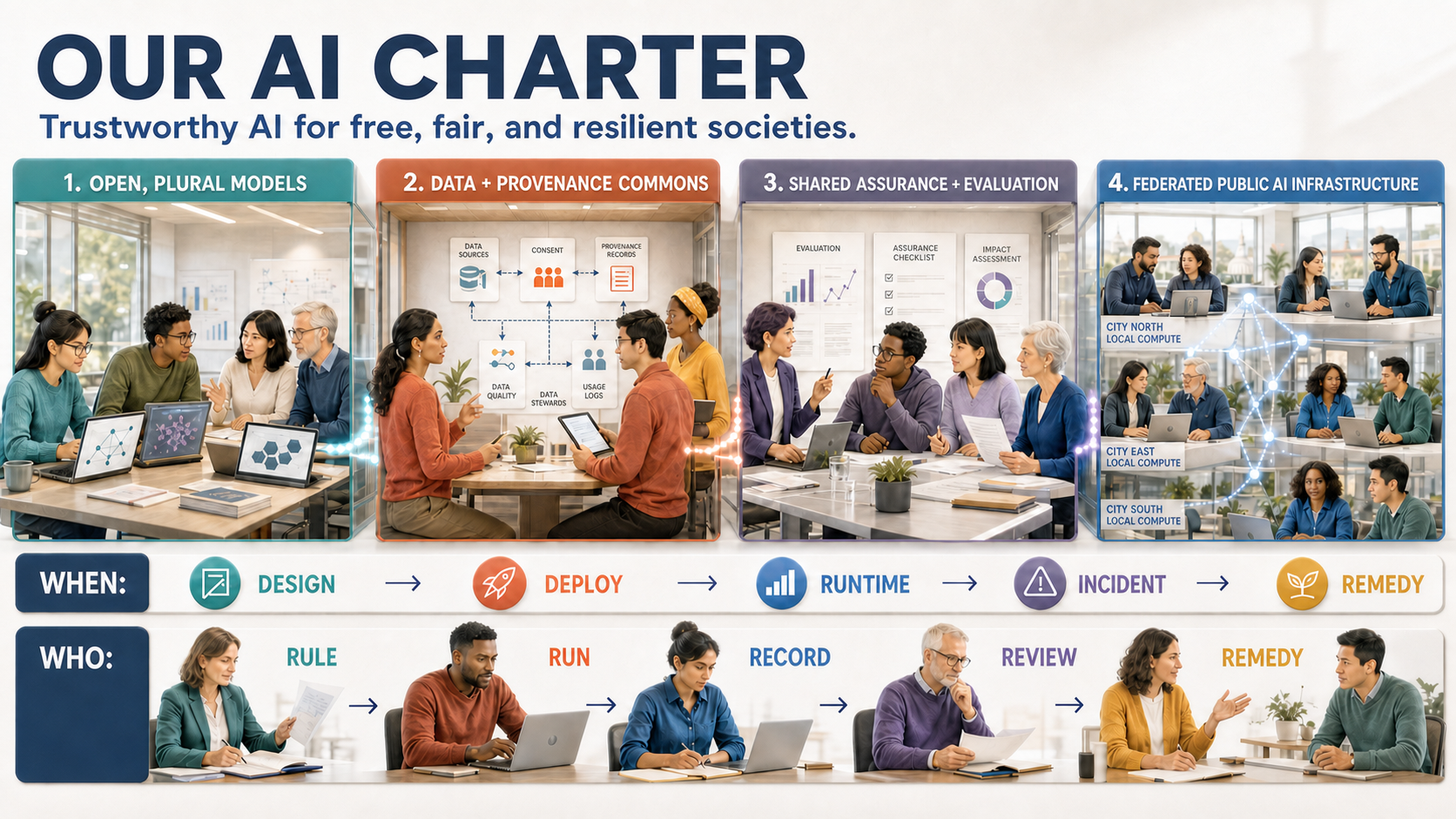
𝗧𝗵𝗲 𝗰𝘂𝗿𝗿𝗲𝗻𝘁 𝗱𝗲𝘀𝗶𝗴𝗻 𝗵𝗮𝘀 𝗳𝗼𝘂𝗿 𝗰𝗼𝗻𝗻𝗲𝗰𝘁𝗲𝗱 𝗽𝗶𝗹𝗹𝗮𝗿𝘀:
- 𝗢𝗽𝗲𝗻 𝗺𝗼𝗱𝗲𝗹𝘀 models whose characteristics users can inspect and compare, enabling them to make an informed choice.
- 𝗗𝗮𝘁𝗮 𝗮𝗻𝗱 𝗽𝗿𝗼𝘃𝗲𝗻𝗮𝗻𝗰𝗲 𝗰𝗼𝗺𝗺𝗼𝗻𝘀 Documented origin, permissions, opt-outs, restrictions, and review routes, with open or protected access according to rights and sensitivity.
- 𝗦𝗵𝗮𝗿𝗲𝗱 𝗮𝘀𝘀𝘂𝗿𝗮𝗻𝗰𝗲 𝗮𝗻𝗱 𝗲𝘃𝗮𝗹𝘂𝗮𝘁𝗶𝗼𝗻 Publicly checkable evidence for what a system claims and how failures are handled, with consequential actions checked as they are composed at runtime—before execution—and rulemaking, operation, evidence custody, independent review, and remedy kept in separate hands.
- 𝗙𝗲𝗱𝗲𝗿𝗮𝘁𝗲𝗱 𝗽𝘂𝗯𝗹𝗶𝗰 𝗔𝗜 𝗶𝗻𝗳𝗿𝗮𝘀𝘁𝗿𝘂𝗰𝘁𝘂𝗿𝗲 Independently operated compute nodes under shared rules.
Project: https://robertschaub.github.io/our-ai-charter/
#PublicAI #AIGovernance #DigitalSovereignty #TrustworthyAI #AIAccountability #OpenModels #Geneva2027
𝘍𝘶𝘭𝘭 𝘢𝘳𝘵𝘪𝘤𝘭𝘦 𝘣𝘦𝘭𝘰𝘸 ↓
Our AI Charter: From Open Models to Accountable Public AI Infrastructure
Editorial note, 2026-10-04: This article reflects its publication date. The current development focus is Evidence-Gated Agents. Public AI, Built Together — Towards Geneva 2027 explains the continuing open path; the earlier proposals below are not current delivery commitments.
Our AI Charter is a proposal for an international network of open AI models under shared public obligations, backed by an independent governance-and-evidence layer.
Participating providers would commit to common public obligations, backed by an independent governance-and-evidence layer and a shared way to find, compare, and reach the systems that take part.
The urgent work is public-AI governance and infrastructure. AI Assurance & Certification is one building block within it: the trust-and-evidence layer that turns broad principles into claims that can be checked.
Why open models are necessary — and not enough
Open, inspectable models are an essential part of digital sovereignty. They widen access, support research and adaptation, and reduce dependence on systems whose inner workings cannot be examined.
But a collection of national models is not yet public infrastructure. A model can be open while the service around it still leaves basic questions unanswered:
- Who decides where a request runs?
- Which model, data, tools, and compute node were actually used?
- What happens when a provider changes, fails, or withdraws?
- Who may inspect incidents and contested claims?
- How can a person challenge an AI-supported decision that affects them?
That is why autarky is not sovereignty. Durable sovereignty is the ability to inspect, co-decide, contest, and switch. Resilience comes from shared standards, lawful data, accountable governance, broadly held competence, and federated infrastructure that no single power can quietly capture or switch off.
One network proposition, held together by four pillars
The current design has four connected pillars:
- Open models — models whose characteristics users can inspect and compare, enabling them to make an informed choice.
- Data and provenance commons — documented origin, permissions, opt-outs, restrictions, and review routes, with open or protected access according to rights and sensitivity.
- Shared assurance and evaluation — publicly checkable evidence for what a system claims and how failures are handled, with consequential actions checked as they are composed at runtime—before execution—and rulemaking, operation, evidence custody, independent review, and remedy kept in separate hands.
- Federated public AI infrastructure — independently operated compute nodes under shared rules.
Under all four sits competence. Infrastructure can be purchased; the ability to understand, govern, and continuously improve it must be built and kept broadly distributed.
This is a contribution to the wider public-AI movement, not a claim of affiliation with any existing Public AI coalition unless explicitly stated. It is meant to add a governance-and-evidence layer to good work already underway — not to replace open-model teams, public compute projects, standards bodies, or existing institutions.
The first buildable layer
The proposed first technical substrate is deliberately small: a model-plural policy broker connected to at least two independently operated compute nodes, plus an evidence plane.
The broker would decide what may run, where, under which purpose and data rules. The evidence plane would keep the records needed to check those decisions: model, node, and evaluation cards; incident and change records; unresolved-risk notes; and public reports where disclosure is safe. Sensitive evidence would require protected, role-based access. Raw personal data should not enter the public plane.
At the decision point, the runtime path is:
plan → prepare → check → decide → review
Plan the use: decide whether AI — and this system — is suitable, who has authority, for what purpose, and within what limits. Prepare the inputs: admit data, sources, and instructions only under the applicable privacy, rights, and confidentiality rules. Check the evidence and carry uncertainty forward. Decide whether the exact output may change a decision or trigger an external action: proceed, hold for human or independent review, or reject. Review the effects and preserve the trace so the decision can be challenged, corrected, and learned from. The corresponding gates are authorize → submit → verify → commit → rely.
The core rule is trace wide, escalate narrow: keep a reviewable record, but interrupt a person only when they can materially change a sufficiently consequential outcome. Irreversible, external, regulated, or person-affecting actions should stop for decision. Autonomous or high-frequency actions may operate inside a human-authorized envelope with defined limits, monitoring, rollback, and a kill-switch. The full runtime reference model carries the detailed triggers and failure actions.
For discovery, the user path should remain simple:
find → check → use
Find a system suited to the need. Check its capabilities, jurisdiction, openness, evidence status, and known limits. Then use it through an accountable service. Discovery itself must remain plural and neutral, because whoever controls discovery can shape the market.
The live ecosystem already supplies important pieces. Apertus demonstrates what a fully open public foundation model can look like. The Public AI Inference Utility shows a model-plural access layer, and has been a supported Hugging Face Inference Provider since 17 September 2025.
The Charter proposal focuses on the layer still needed around such capabilities: purpose limits, accountable routing, evidence duties, independent assessment, contestability, and protection against capture.
What the trust-and-evidence building block adds
A provider's own “trustworthy AI” label is a declaration, not independent assurance. The assurance work starts elsewhere: with questions that should be answerable.
What is the system for? Who controls it? What data is it built on and connected to? Who is accountable? How can people challenge it? Who may inspect it? Can its claims, changes, and failures be checked?
The draft Charter Commitments turn those questions into five public obligations and eight operational duties. The first evaluation module tests one narrow part: whether a factual AI system shows its work faithfully and gives users a meaningful way to contest it.
Certification is not the first step. The draft certification model sets out a credible sequence: a published method, bounded independent evaluations, public reports, and a report index. Any future mark would require separated roles, appeal and revocation, and claims limited to the system, version, use, jurisdiction, and modules actually assessed.
What exists today — and what does not
This is still Phase 1: public drafting and connection-building.
There is no public front door, admission body, assessor, adjudicator, register, certificate, trust badge, or live evaluation pilot. No model or provider is Charter-certified. Prospective coalitions, roles, and processes are intent, not fact.
What exists is a public, inspectable body of work:
- a plain-language network design;
- a federated infrastructure architecture and pilot sequence;
- draft Charter obligations;
- a first evaluation method; and
- a public strategy and evidence base that can be criticised, corrected, or stopped if it does not earn support.
That maturity boundary is not a disclaimer at the edge of the project. It is part of the proposition: public-interest AI governance should distinguish clearly between what is proposed, what has been independently checked, and what is actually operating.
A bounded next step toward Geneva 2027
The near-term goal is a Geneva 2027 Public AI Governance & Evidence Package:
- a neutral clarification process with prospective institutional anchors;
- a governance blueprint for a model-plural, capture-resistant network;
- one bounded evidence-and-evaluation pilot outline; and
- a path to a multi-stakeholder roundtable.
This fits the official Road to Geneva, which is intended to bring governments, business, research, and civil society into thematic pre-events and consultations before the June 2027 summit.
The route is alliance and mandate first, lawmaking later. The initiative is incubating in Switzerland as a possible neutral host and bridge — not as owner — and is international by design.
An invitation to make it harder to overclaim
The most useful help now is specific:
- Builders and researchers: show where the proposal duplicates existing work, and where its evidence duties are unrealistic or incomplete.
- Policy and institutional leaders: test whether the governance package answers a real need and what kind of neutral home could legitimately carry it.
- Standards, assurance, and civil-society practitioners: pressure-test independence, inspection rights, contestability, and anti-capture safeguards.
- Connectors and funders: open one useful door or support one concrete deliverable — not an institution in search of a purpose.
The project is public because its claims should be contestable from the beginning. If this touches your work, I would value criticism, related examples, and introductions to people who should be in the room.
Project: Our AI Charter
How to contribute: CONTRIBUTING
Contact for non-public matters: info@factharbor.ch
Previous articles
- Trustworthy AI, Accountable to People
- KI-Souveränität und Resilienz
- The Public AI Network: Building Sovereignty and Resilience for Free Societies
- Runtime AI Governance Gets When Right. The Harder Question Is Who Gets to Check?
- The Swiss Autarky Illusion: Why Digital Sovereignty Cannot Be Built Alone
#PublicAI #AIGovernance #DigitalSovereignty #TrustworthyAI #AIAccountability #OpenModels #Geneva2027