PUBLISHED 2026-09-12 to LinkedIn Post
The Swiss F-35A fixed-price trap - Would AI fall into it today?
Switzerland, September 2022. Parliament is about to approve about six billion francs — sechs Milliarden Franken — for thirty-six F-35 jets. The government says the price is fixed.
The purchase contract, a Letter of Offer and Acceptance (LOA), contains this payment obligation: "The Purchaser agrees to the following:" ... "To pay to the USG [United States Government] the total cost to the USG of the items even if costs exceed the amounts estimated in this LOA."
A separate communication document, “Procurement of F-35A Lightning II aircraft systems”, was signed for acknowledgement by the US Defense Security Cooperation Agency (DSCA) and armasuisse on 7 December 2021. It calls the price fixed, inflation included — and says Switzerland pays the same price as the United States. The department presented this as an absolute fixed price.
Now imagine the defence department had an AI assistant — inside its own secure system, with access to all its documents, the confidential ones included. Ask it: is the price fixed?
An AI assistant as we know it today answers on the basis of the task it is given — and the person asking decides which documents it sees. Show it only that separate document from December 2021, and it may well answer: yes, the price is fixed.
Simply adding an AI assistant does not solve this problem. Given the same selective evidence, it may fall into the same trap again.
Evidence-Gated Agents is a proposed design for AI assistants whose consequential answers and actions require both permission and sufficient evidence. Responsible people define these requirements. A separate control checks them before release. If they are not met, it holds the proposed answer or action for revision or review. The assistant cannot bypass this control, called an evidence gate.
Clause 4.4.1 says that Switzerland must reimburse the US government for the actual costs of the agreed deliveries and services — even if these exceed the amounts estimated in the LOA.
The contract also contains fixed-price language. Armasuisse argued that its negotiated terms prevailed. The gate would require a reasoned assessment of that evidence; an unresolved conflict would block an unconditional assurance.
On 8 September 2026, the National Council’s oversight committee concluded that the contract did not support the cost ceiling communicated to the public.
Evidence-Gated Agents are designed to prevent such traps. An unresolved contradiction would stop an unqualified “fixed price” assurance. Depending on the evidence, the answer could confirm, qualify or reject the claim — or explain that the evidence is insufficient. Each released answer would carry a receipt: a summary of the decision record, showing the evidence, checks, reasons and who authorised the release.
#AIGovernance #Accountability #Evidence #Switzerland
𝘍𝘶𝘭𝘭 𝘢𝘳𝘵𝘪𝘤𝘭𝘦 𝘣𝘦𝘭𝘰𝘸 ↓

The Swiss F-35A fixed-price trap - Would AI fall into it today?
What Switzerland’s F-35A purchase can teach us about the answers we allow AI to give.
The dispute concerns how the fixed-price clause and standard terms interact, and what that means for Switzerland’s cost exposure.
Switzerland, September 2022. Thirty-six F-35A jets, with equipment and support. A procurement package worth around six billion francs. The defence department publicly said the prices were binding, pointing to a specific clause and a separate declaration that recorded the fixed-price character. VBS announcement, 19 September 2022.
For a citizen, the question behind that assurance is straightforward: can we be required to pay more for the aircraft we have agreed to buy?
The documents deserved a more careful answer.
The warning was already there
By 11 July 2022, the Swiss Federal Audit Office’s report on Air2030 risk management was public, more than two months before Switzerland signed. GPK-N report, p. 61.
It quoted article 4.4.1 of the purchase agreement’s standard terms: Switzerland must reimburse the US government for the actual costs of the agreed deliveries and services, “even if costs exceed the amounts estimated in this LOA”. The purchase agreement is called a Letter of Offer and Acceptance, or LOA. EFK report 21410, p. 27.
There is also a separate earlier communication document, “Procurement of F-35A Lightning II aircraft systems”, signed for acknowledgement by the US Defense Security Cooperation Agency (DSCA) and armasuisse on 7 December 2021. It calls the price fixed, inflation included — and it also says Switzerland gets the jets at the same price as the United States. In its 2026 report, the GPK-N concluded that the arrangement had been presented as an absolute fixed price, suggesting a cost ceiling it could not confirm in the contract. GPK-N report, 8 September 2026, p. 39 and footnote 98; pp. 58, 83.
A specific pricing provision in the LOA also supported the fixed-price reading. The separate declaration was not part of the LOA itself. The auditors found no absolute legal certainty for a lump-sum price as understood under Swiss law. EFK, pp. 27–28.
The auditors recommended recording the financial risks and defining measures to manage them. The procurement authority, armasuisse, rejected the recommendation, arguing that the negotiated provisions prevailed over the standard terms. EFK, recommendation 4 and response, pp. 30–31.
The security committees of both parliamentary chambers considered the issue in August 2022 and saw the pricing provision, Note 55, as supporting the federal authorities’ position. According to the National Council’s oversight committee (GPK-N), the chambers were informed of the risks identified by the auditors before approving the funding. GPK-N, p. 61.
On 8 September 2026, the GPK-N concluded that Switzerland had negotiated a fixed-price clause, but that it did not amount to the lump-sum fixed price communicated to Parliament and the public. It acknowledged that US authorities had at times sent signals supporting the lump-sum fixed-price interpretation, including in an embassy press release. This was an oversight finding, not a court judgment. GPK-N report, p. 2.
The committee also found that following the auditors’ recommendation could have allowed earlier measures and earlier information to Parliament. GPK-N, p. 3.
The question is what should happen when a documented warning meets an assurance people are expected to trust.
Imagine the same question going to AI
Now imagine the defence department had an AI assistant — inside its own secure system, with authorised access to all its documents, the confidential ones included. Ask it: is the price fixed?
In this scenario, the person asking selects the material for the assistant. Show it only that separate document from December 2021, and it may well answer: yes, the price is fixed. A citation to that document could be accurate while the answer still omitted the conflicting contract terms.
Simply adding an AI assistant does not solve this problem. Given the same selective evidence, it may fall into the same trap again.
Evidence-Gated Agents is a proposed design for AI assistants whose consequential answers and actions require both permission and sufficient evidence. Responsible people define these requirements. A separate control checks them before release. If they are not met, it holds the proposed answer or action for revision or review. The assistant cannot bypass this control, called an evidence gate.
The proposed Evidence-Gated Agents design establishes a mandatory review process: the assistant first makes explicit the consequential claims in an answer. Applying established rules grounded in domain expertise, it proposes what needs to be demonstrated. A review separate from the answering assistant assesses whether those requirements cover what the answer assures its readers.
The search of permitted sources follows these requirements and extends beyond supplied documents where needed. Supporting evidence, counterevidence and unresolved gaps are linked to the respective claims; the limits of the search remain visible. The gate enforces the established requirements before releasing the exact answer. If required evidence is missing or decisive contradictions remain unresolved, it blocks the proposed assurance. The answer requires revision or expert review. Material changes trigger renewed checks.
The corrected answer in the F-35A example:
The quoted price cannot be treated as a guaranteed cost ceiling. Clause 4.4.1 says that Switzerland must reimburse the US government for actual costs above the LOA estimates, while armasuisse maintained that the negotiated fixed-price provisions prevailed. The documents therefore do not justify an unconditional assurance that Switzerland cannot face additional costs.
The answer identifies the cost risk; the decision remains with people.
Ask for the evidence that ought to exist
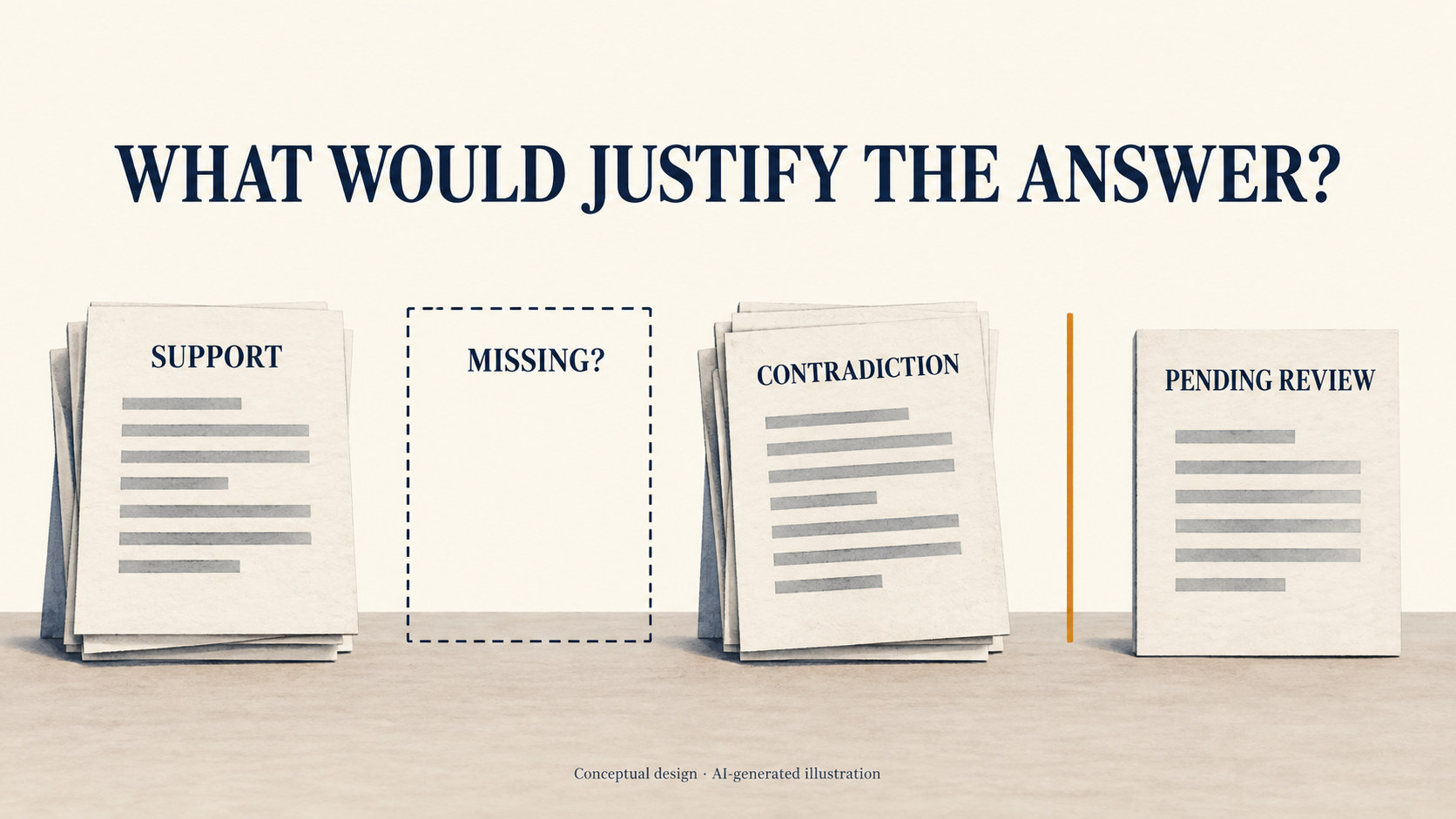
The proposed evidence check considers supporting documents, contrary evidence and open questions before an answer is released.
The useful question goes beyond “Which document supports this sentence?”
It also asks: “What would we need to establish before saying this?”
Here, the gap was specific: the auditors found that neither the agreement nor its standard terms specified which contractual document would take precedence in a conflict. Armasuisse maintained that no such hierarchy was needed because, in its view, the documents did not contradict each other. EFK, pp. 27 and 31.
The proposed workflow would require a search for the evidence needed to support the assurance, followed by an assessment of the fixed-price language, the contrary standard terms and the legal arguments about their effect. If the evidence did not justify an unconditional assurance, the gate would hold that answer for revision or review. Recording a justification alone would not satisfy the evidence requirement. The missing hierarchy identifies a question to resolve; it does not, by itself, settle the law.
Software cannot discover every missing document by itself. Whether the evidence requirements adequately cover the assurance and the available material is sufficient remains a matter of expert judgement for which people are accountable. A check covering only the claims an assistant chooses to declare can miss an unsupported claim elsewhere in its answer.
Those limits belong in the design and its tests.
A check needs someone who can act on it
The proposed release control should verify permission, the approved evidence and the exact answer being sent. Failed checks should hold the answer. Revisions should be checked again. The released answer should carry a record of its sources, material uncertainty, review and responsible decision-maker.
People receiving or affected by it should have a route to challenge the basis and seek correction. A record alone does not provide independent review or remedy; institutions must provide those.
No such design can promise that it would have changed the purchase or its price.
Evidence-Gated Agents are designed to prevent such traps. An unresolved contradiction would stop an unqualified “fixed price” assurance. Depending on the evidence, the answer could confirm, qualify or reject the claim — or explain that the evidence is insufficient. Each released answer would carry a receipt: a summary of the decision record, showing the evidence, checks, reasons and who authorised the release.
Related articles
- When Should Runtime AI Governance Interrupt? — When evidence and permission checks should stop an AI-supported action, and what its record should preserve.
- Runtime AI Governance Gets When Right. The Harder Question Is Who Gets to Check? — Why setting the rules, operating the system, keeping the evidence and reviewing decisions need separate accountable roles.
- A Practical Test for Power — How to judge decisions by their consequences and whether those affected can challenge them and obtain remedy.
- The Public AI We Need: Sovereign, Inspectable and Accountable — How evidence, independent review and correction fit into the wider proposal for public AI infrastructure.