TRANSLATION of PUBLISHED 2026-06-20 to LinkedIn Post
An open Swiss AI model is a strong impetus. But how do we secure our digital sovereignty and resilience over the long term? Switzerland as an international bridge-builder for a free and independent AI infrastructure. The building blocks are ready. Read the article ↓
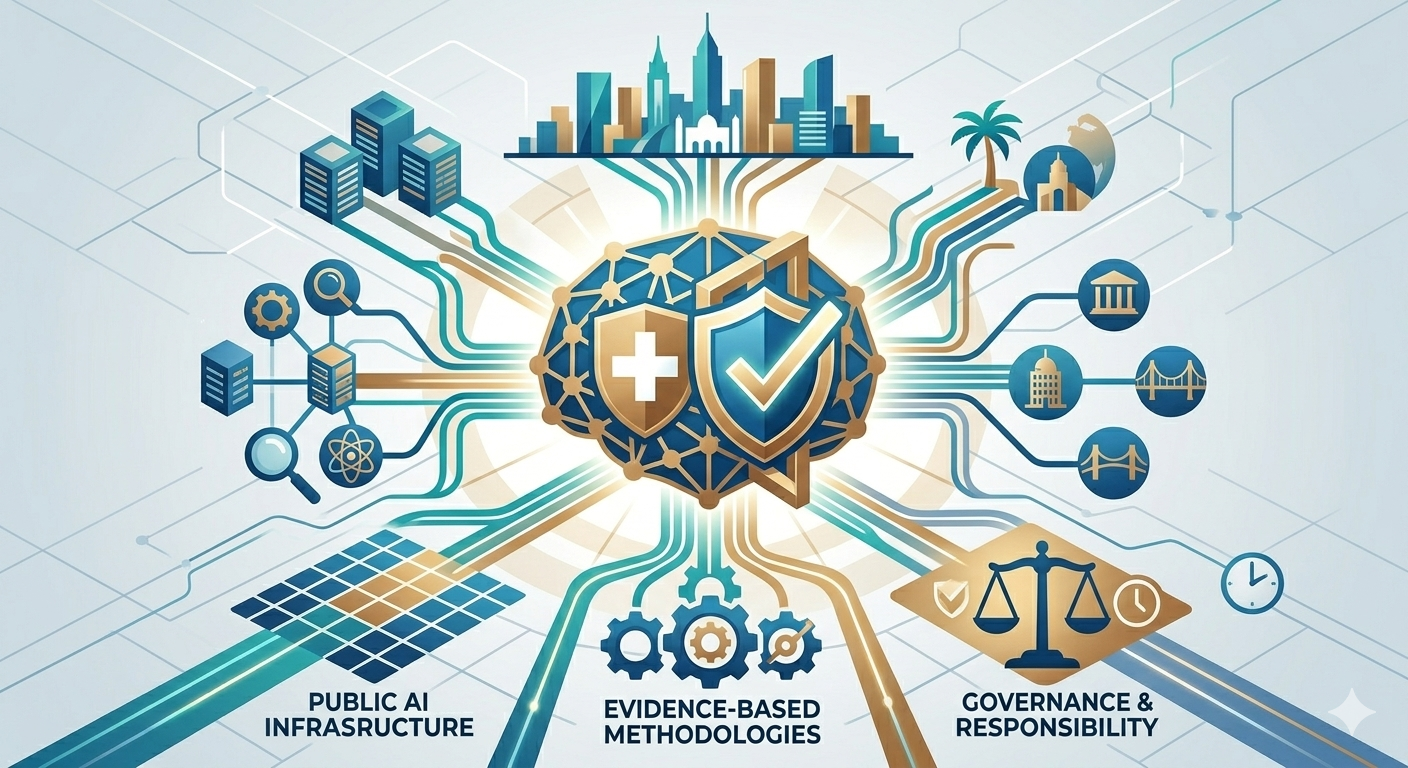
AI Sovereignty and Resilience: Using Switzerland's Innovation Hub to Strengthen the Values of Free Societies Internationally
Marcel Salathé has, in recent weeks, reinvigorated the debate around an open Swiss AI model with a strong contribution. The impetus to invest substantially in our digital sovereignty is important, and I share it. For such an undertaking to achieve its full impact, however, I would like to add two central goals to the debate:
1. Rigorous governance as the basis for trust: Trust in artificial intelligence does not arise from a "Made in Switzerland" label alone. True sovereignty and resilience grow out of rigorous transparency. We need a clear governance layer: transparent assumptions, publicly verifiable methods, evidence-based proof of how systems behave in the real world (see also my recent article on system evaluation), and clearly defined responsibilities — protected against both political and commercial capture.
2. An international hub for free societies: In my view, such an undertaking must not be conceived too narrowly as a purely national project. Switzerland has the greatest leverage when it does not build in isolation, but instead uses its own innovation hub as a credible host and bridge-builder — for an internationally supported and governed public-AI infrastructure that serves the values of free societies.
What is remarkable is that Switzerland already has excellent building blocks for both of these aims.
- With Apertus, there is a publicly funded and fully open language model (EPFL, ETH Zurich, CSCS) that offers exactly this technological transparency in weights and methods.
- The Swiss National AI Institute (SNAI) of ETH and EPFL — with its Swiss AI Initiative — brings together the country's leading research.
- As a partner country of the Current AI initiative, we are already internationally connected. Initiatives such as Expedition Zukunft and digitalswitzerland, as well as actors from International Geneva, further show that the methodological and diplomatic expertise for such multilateral processes is present in the country.
- And the AI Summit 2027 in Geneva offers us a tangible, fast-approaching window of opportunity.
The technological and institutional foundation is therefore impressive. The task for the next phase now consists of making what already exists durably trustworthy and able to connect internationally, through binding rules and clear responsibilities.
Such a governance layer does not have to be built from scratch. We can connect directly to the established structures of SNAI, the open principles of Current AI, and the strong foundation of our universities. I look forward to the discussions and conversations on these themes and undertakings in the coming weeks — and to every contribution from actors who wish to help shape this undertaking together.
Because true digital sovereignty and resilience unfold only within a network: they mean shaping the infrastructure of the future together and internationally, according to the values of free societies.
— Robert Schaub
German original: KI-Souveränität und Resilienz.