Analysis pipeline
The planned pipeline connects an exact question to permitted evidence, an assessment people can challenge, and a report released to its intended reader. Claim assessment and decision comparison share evidence and reporting, while using distinct analytical methods.
This is the broader proposed design, not an implemented workflow. Stage 1 covers claim checking with public web sources and saved evidence. Decision comparison and the additional-agent debate route are later scope, subject to evaluation. More agents are not themselves evidence of better results.
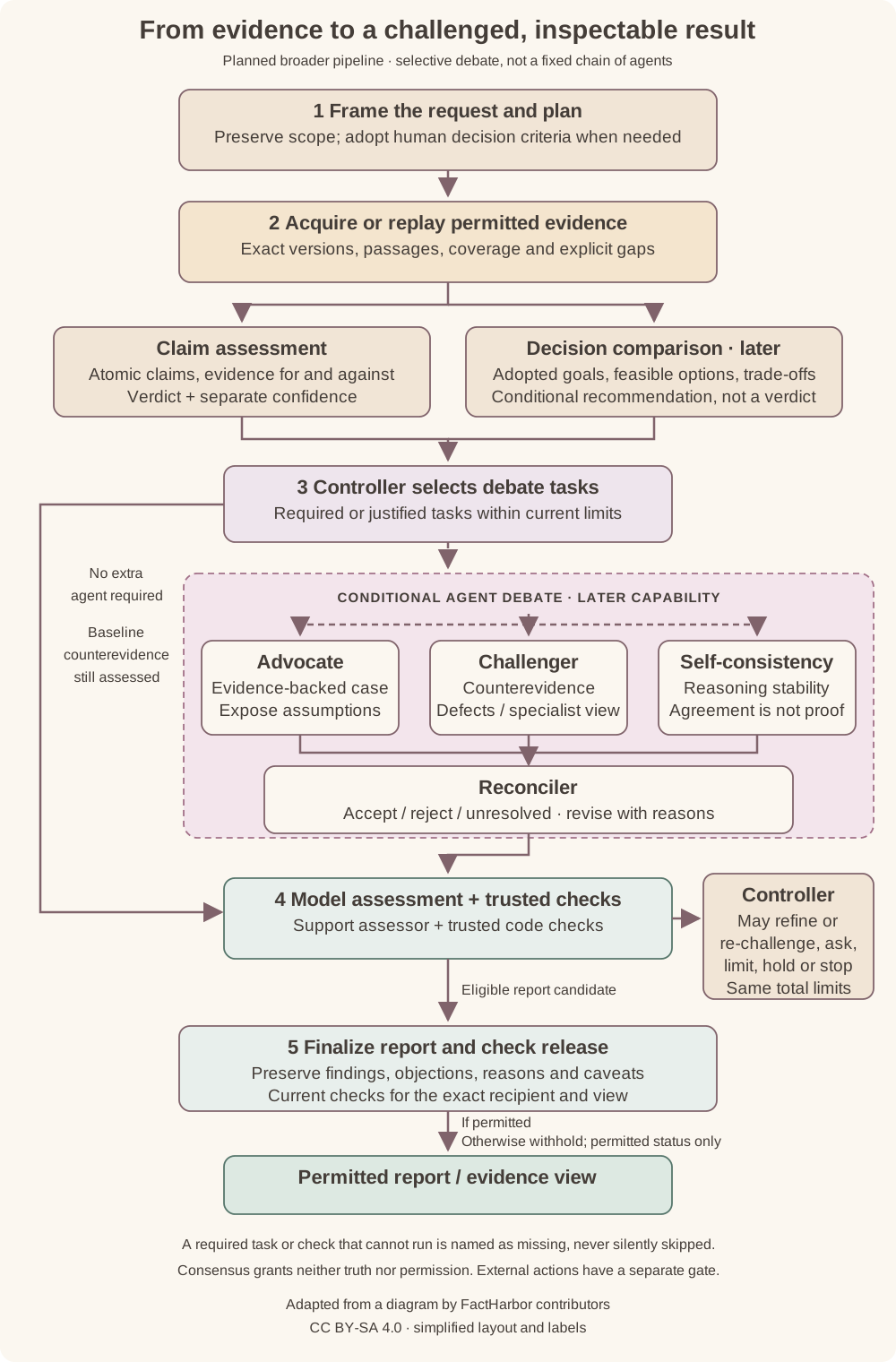
Open the diagram for a larger view. The “Conditional agent debate” panel contains possible debate tasks; it does not prescribe all roles, parallel dispatch or a fixed number of model calls. The support assessor is represented in step 4 alongside trusted code checks; both apply on both routes.
Simplified adaptation of the FactHarbor/DSS design. Attribution: FactHarbor contributors · CC BY-SA 4.0 · Public visual lineage.
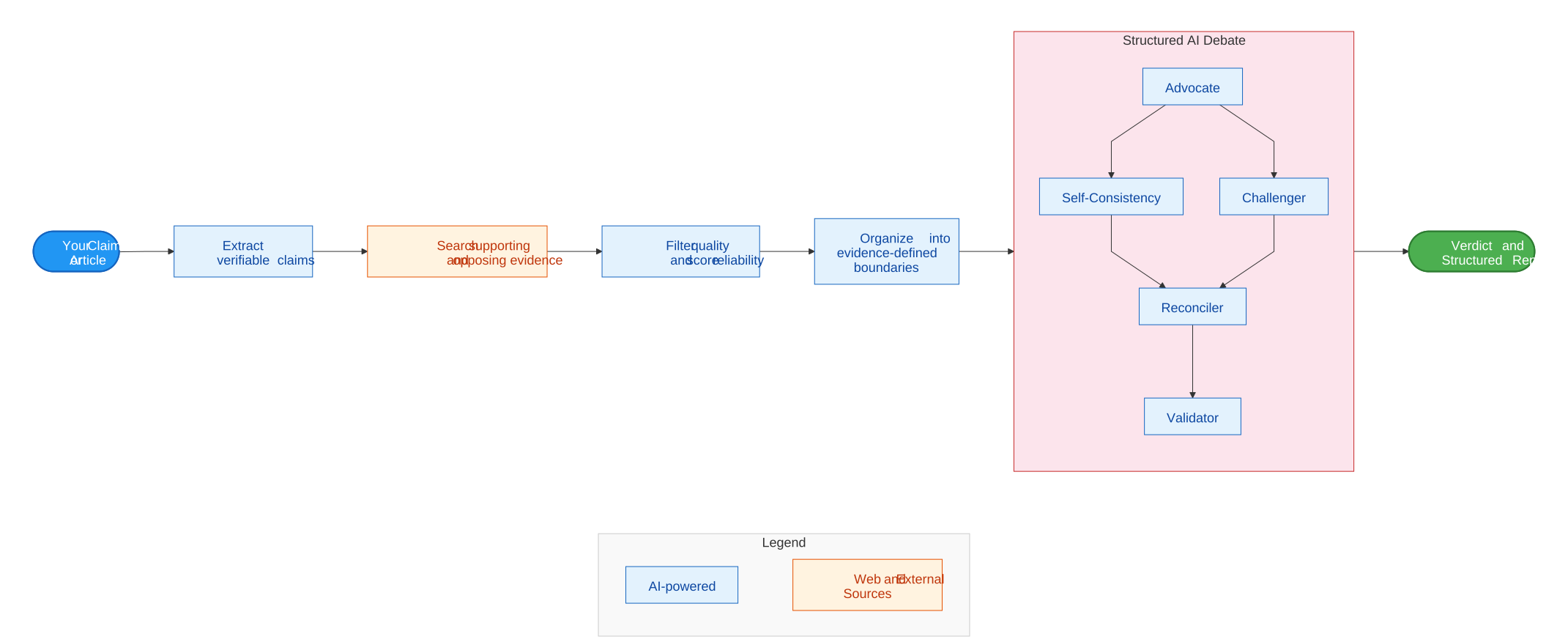
What the agents would contribute
The controller selects only required or justified tasks, their dependencies and their permitted inputs. Each task works against the exact evidence and assessment versions it was assigned.
| Task | Contribution |
|---|---|
| Advocate | Explain the evidence-backed case, including assumptions and limitations; do not defend a preferred answer regardless of evidence. |
| Challenger / specialist | Examine counterevidence, alternative explanations, citation or scope defects, or a specific expert question. |
| Self-consistency | Examine instability or contradictions on comparable inputs. Repetition and agreement add no independent evidence. |
| Reconciler | Accept, reject or retain each material objection as unresolved, with reasons; revise affected findings where justified. |
| Support assessor | Judge whether the cited passages support each atomic claim; this remains a model judgment, labelled as one, from a method that must pass independent evaluation before routine use. Trusted code separately checks that references exist, that quotations match the saved text, and typed dates, versions and arithmetic. |
These are task roles, not necessarily five permanent agents or five different models. Different role names do not establish independence. Failed or cancelled tasks are reported, not dropped.
Challenge without voting or endless retries
The baseline assessment would already examine counterevidence, including a search for contradicting evidence for each atomic claim. When no extra agent is needed, the direct path still undergoes mandatory checks. A required challenge cannot be skipped because another agent agrees. If it cannot run, for example because the budget has run out, it is reported as missing; see gaps, limits and corrections.
Reconciliation follows the substance of an objection, not the number of agents supporting it. A demonstrated reasoning or quotation defect can justify correction without a new source; unsupported disagreement does not automatically lower a verdict or its confidence. Material unresolved issues constrain the conclusion and its intended use.
The controller may refine, ask a person, or return a limited result, hold or stop; further rounds do not reset limits. In a plain fact-check, analytical findings never stop the work or prompt questions; they are named in the report.
From candidate to permitted report
Reports retain material objections, dispositions, changes, reasons, uncertainty and stopping conditions—not raw debate transcripts. Only a structurally valid candidate becomes a fixed report edition; in fact-checking it marks any remaining contradictions and excluded evidence. Recipient-specific access, disclosure, quality and any required human review still govern release; a misleading redaction must be withheld.
A report is a basis for decisions, not permission to act. External actions have a separate authorization and execution path and are outside this simplified diagram.
See the principles, the system architecture and how it would work.